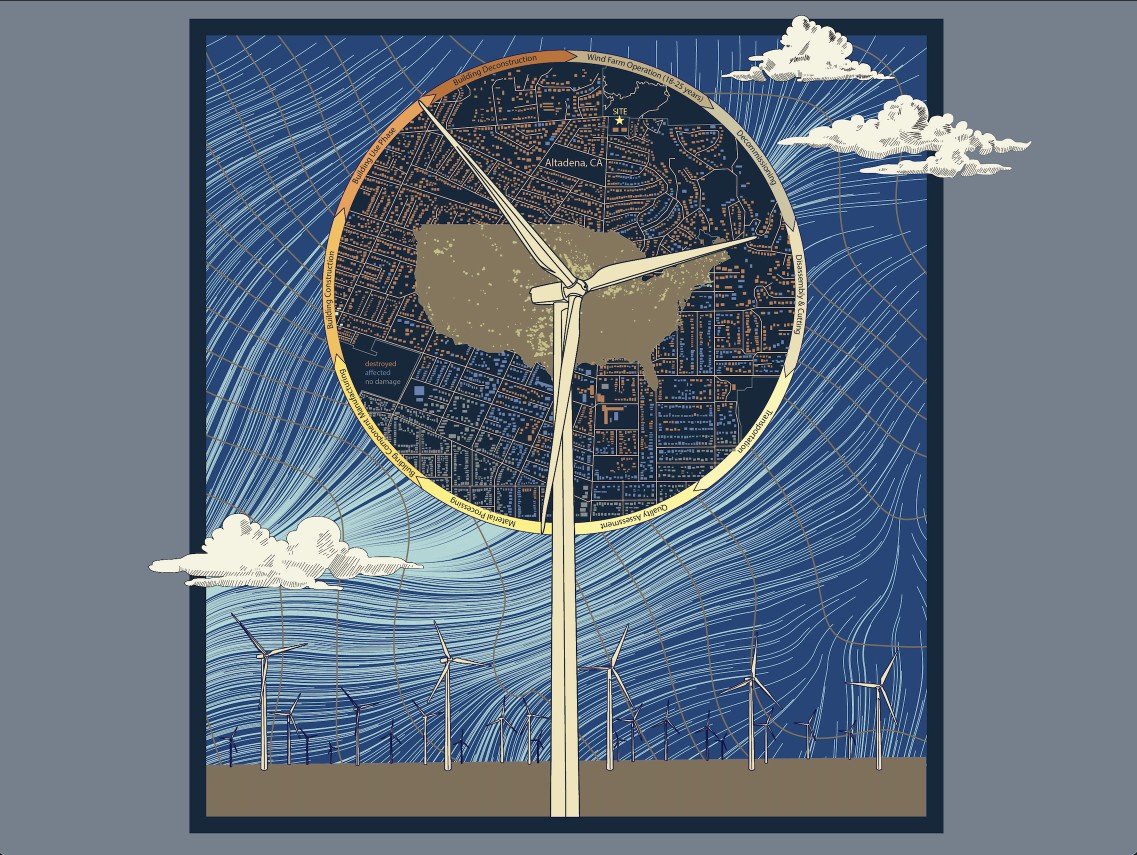
Since humans first built shelters, architectural form has been dictated by material availability—a fundamental principle that modern construction practices have abandoned through unsustainable extraction cycles. This thesis reclaims and reframes this logic for contemporary practice through a comprehensive urban mining framework that reconceptualizes industrial waste as collective architectural resources. Using decommissioned wind turbines as a primary case study, it demonstrates how systematic material recovery can address both environmental sustainability and housing affordability while responding to immediate climate-related disasters. With 70,800 wind turbines currently operating in the United States, and projections showing over 3,000 blades reaching end-of-life annually by the 2030s—potentially generating 2 million tons of waste in the U.S. alone by 2050—this framework establishes a scalable system for material recovery and redistribution. Drawing on Elinor Ostrom’s understanding of common-pool resource management, the approach creates a collectively managed material bank where recovered industrial components become accessible building materials for affordable housing developments on city-owned land. Situated on a vacant lot in Altadena, California—a neighborhood devastated by recent wildfires—this proposal directly addresses the urgent need for recovery and reconstruction. The site plan follows the natural topographic water flow to prevent mudslide damage, directing water into an existing abandoned reservoir. By reintegrating engineered composites into residential architecture, the framework reduces construction costs while advancing material-driven design methodologies where form again follows availability. This shift from extraction to curation fundamentally transforms architectural practice, reconnecting it with its historical roots while addressing contemporary challenges of sustainability, waste management, housing accessibility, and climate resilience in urban environments.
FORM FOLLOWS AVAILABILITY: Urban Mining and the Architecture of Collective Resources