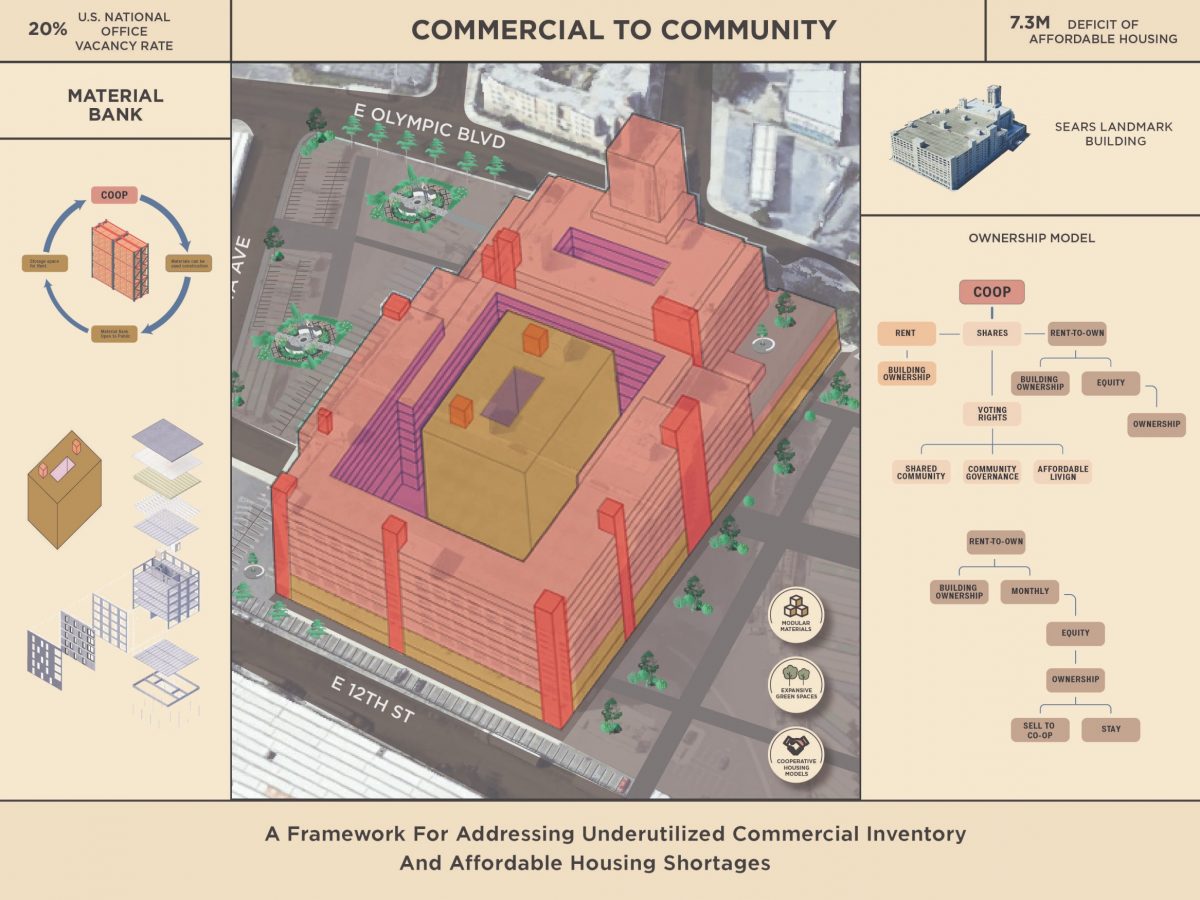
U.S. cities are grappling with a post-pandemic paradox: while 20% of commercial spaces—including office buildings—sit vacant, the country faces a shortfall of 7.3 million affordable homes, leaving just 34 available units per 100 low-income households. Commercial to Community addresses this disconnect by proposing a mutually reinforcing solution: transforming underused commercial assets into frameworks for non-speculative housing and circular entrepreneurship. Using the vacant Sears Building in Boyle Heights as a test case, the project reimagines adaptive reuse through two interlinked limited equity co-operatives. The Material Bank Co-op repurposes the bulk of the building into a general storage facility (gradually phased out) that generates early revenue. It also houses a permanent Material Bank—a hub for storing, researching, and testing circular construction materials as well as developing knowledge and skills for disassembly processes. In parallel, the Rent to Own – Own to Rent Co-op begins transforming the building’s frontage into housing. Here, Rent to Own members build equity through monthly payments, while Own to Rent members access stable, affordable rental options. As the residential program gradually expands into the former storage areas, the Material Bank continues to supply reclaimed materials for the construction industry across the city and produce modular (potentially resident-designed) plug-and-play elements. These enable co-op members to configure, merge, or customize their living spaces with flexibility and ease. By merging circular construction processes, incremental design, and collective ownership, Commercial to Community offers a replicable blueprint—where affordability, adaptability, and sustainability aren’t competing goals, but foundational principles of a resilient urban future.
COMMERCIAL TO COMMUNITY: Co-operative Material Banking for Non-speculative Housing – Circular Strategies for Reuse and Collective Ownership