
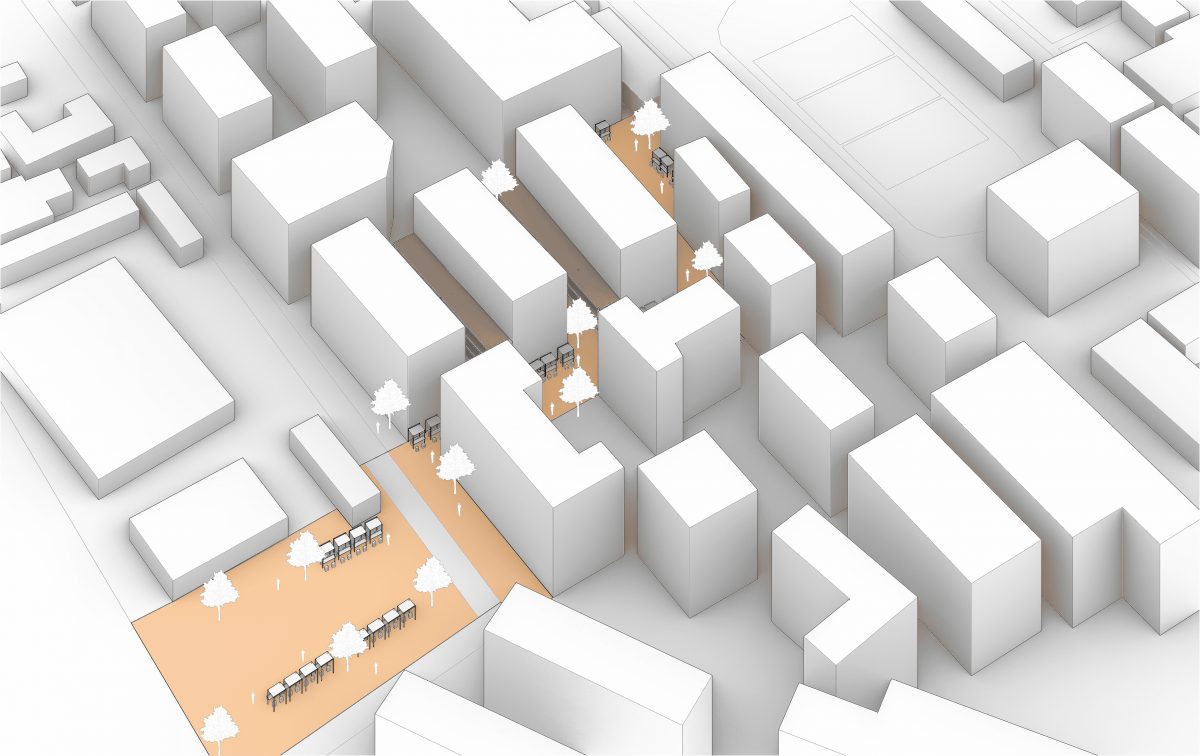
My thesis explores how modular design can transform overlooked urban gaps into a dynamic network of third spaces—flexible platforms for social and cultural exchange that evolve with time and community needs.
The project reactivates underused paths and spaces by clearing informal enclosures, restoring pedestrian flow, and introducing a multi-layered system organized as points, lines, and planes:
- Points: Functional hubs like tea houses, shared kitchens, or temporary markets;
- Lines: Pathways and elevated walkways that reconnect fragmented communities;
- Planes: Courtyards and open grounds for collective events and long-term engagement.
In smaller or more peripheral residential areas, I propose lightweight devices that blend into facades using local materials, taking no space when idle but unfolding into usable third spaces when needed. These installations act as spatial clues dispersed throughout the city.
Their materials and design language are reassembled and expressed in the larger functional nodes, creating a spatial rhythm: the small devices hint at a larger system, pathways serve as connective threads, and each node becomes a convergence point that gathers and amplifies interaction.
This strategy uses local, low-tech, and replicable components, encouraging participation while embedding cultural continuity. It offers a light, adaptable, and human-scaled approach to urban regeneration—where third spaces act as connective tissue, bridging people, neighborhoods, and eras.