
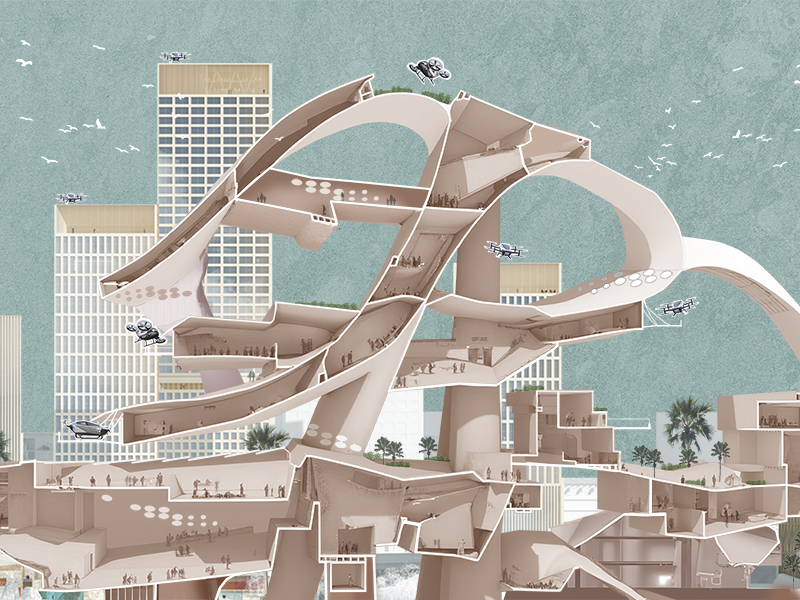
In the near future, as humans live increasingly isolated lives within high-density vertical towers, traditional circulation systems will no longer suffice. With advancements in vertical mobility, such as passenger drones, architecture must adapt to facilitate multidimensional movement and social interaction. This thesis explores neuroscience-inspired circulation strategies that are incorporated into vertical architecture system. Drawing from neural networks, these pathways will be designed using AI-generated spatial patterns and computational creating intuitive, organic circulation systems. Rather than mere passageways, these structures will foster engagement and counteract isolation, transforming circulation into an
immersive spatial experience. By integrating neuroscience aesthetics and emerging mobility technologies, this project envisions a new architectural paradigm where buildings can be programmed into vertical cities that promote connection, interaction, and fluid movement beyond traditional corridors and elevators.