
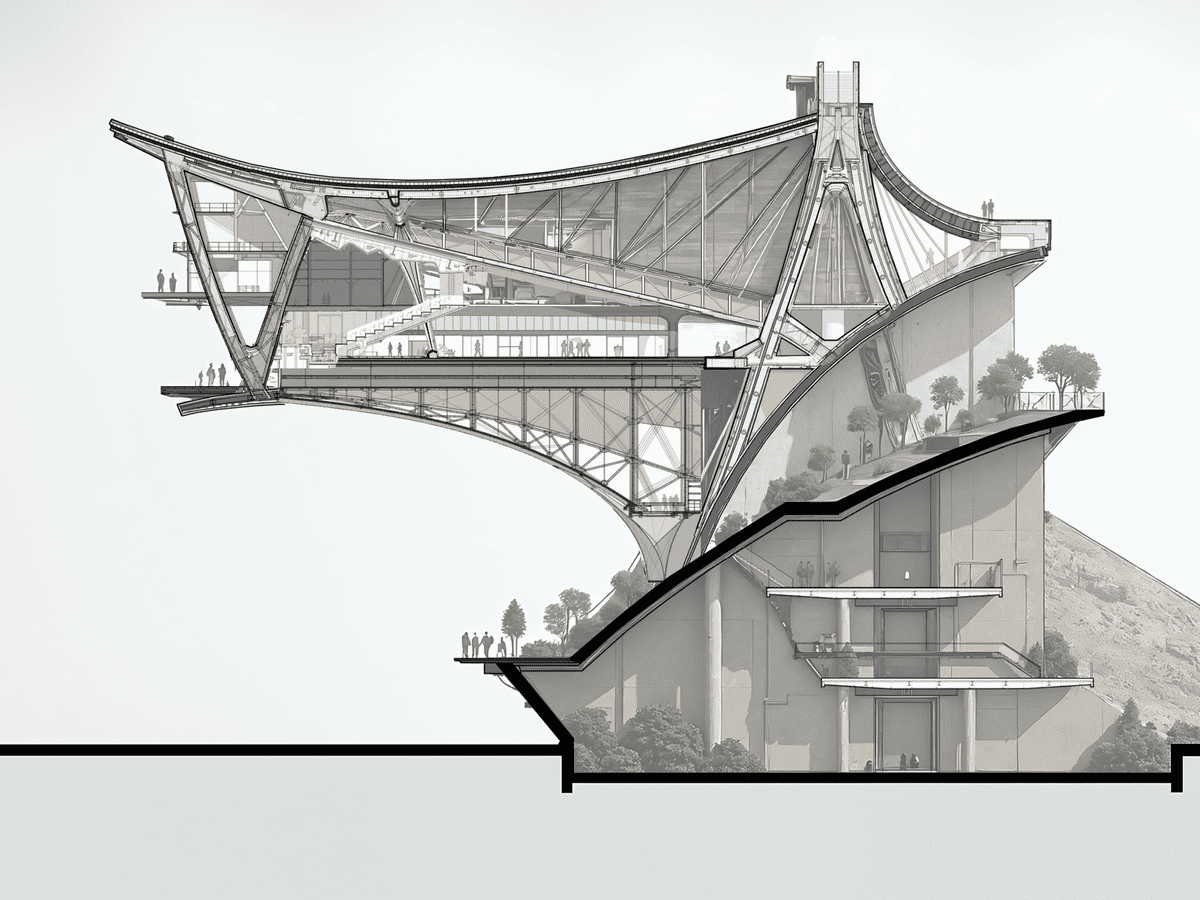
This research examines how object relationships encoded in AI embedding spaces manifest as formal properties through vicarious causation, where AI-generated forms reveal dormant connections between objects. Through Object-Oriented Ontology and vector space analysis, we investigate how AI mediates object relationships in architectural design, suggesting that AI latent spaces partially model a deeper topology containing all possible object relationships.
By analyzing how AI systems leverage lexical hierarchies across modalities—from image generation (Stable Diffusion, DALLE) to 3D synthesis (MeshGPT)—through WordNet-based datasets (MS COCO, ImageNet, ShapeNet), we explore how latent spaces encode object relationships. The persistence of WordNet’s hypernym-hyponym relationships across evolving transformer AI systems indicates that lexical hierarchy fundamentally structures AI understanding, independent of output modality.
While human perception shapes lexical relationships through labeled datasets, the vector transformations in latent space constitute relationships between real objects. This research leverages these transformations to establish an architectural language where proto-architectural objects, united by shared formal principles, can be combined while maintaining their distinctness. This shifts the architect’s role from form-maker to curator of object relationships, positioning non-architectural objects as active agents in AI-mediated design intelligence and suggesting new directions for architectural pedagogy and practice.