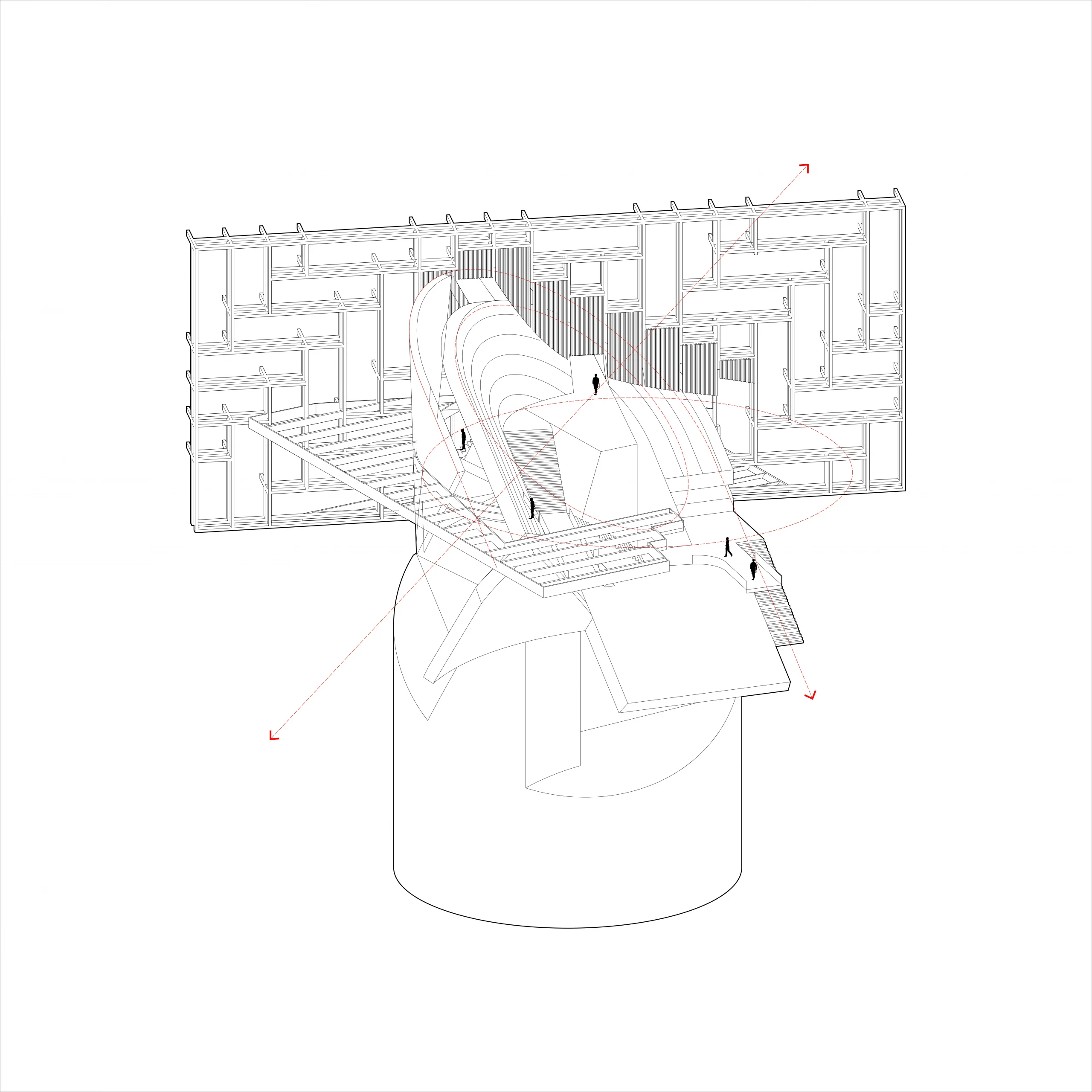
This thesis investigates threshold space as a generator of architectural experience. Rather than treating thresholds as thin, functional boundaries between inside and outside, the project explores how they can become spatially thick, layered environments that intensify the experience of passing through space. Thickness, material layering, and spatial tension are used to transform moments of transition into inhabitable architectural conditions.
The research draws from the historical precedent of Filippo Brunelleschi’s dome of the Florence Cathedral, which employs double-shell constructions to create intermediate zones of circulation, concealed space, and layered spatial experience. Building on this precedent, the thesis introduces shifted central pivots and tangential geometries, using spheres, cones, and tangent planes derived from their circular profiles to generate tensions between curved surfaces and linear movement. The project is developed as a church and plant conservation space, where viewing, circulation, contemplation, and environmental systems intertwine to blur the boundaries between building and landscape.