Student Name: Weican Xue
Instructor: Wes Jones
Current homeless aid systems are largely premised on relocation, requiring individuals to leave their existing territories and enter centralized shelters. Such systems creates exclusion in practice, discouraging participation—particularly for those with limited mobility or established survival routines tied to specific locations.
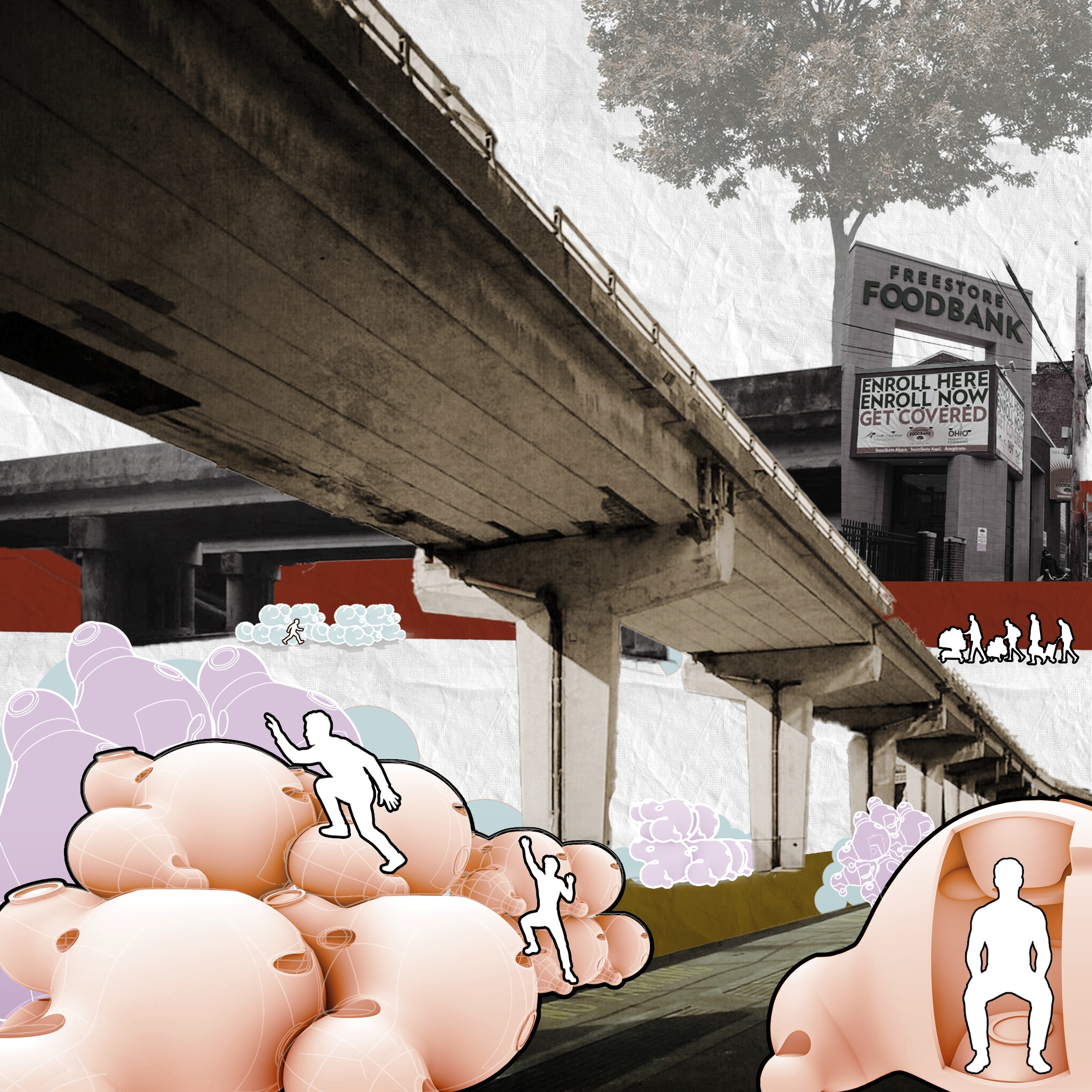
Meanwhile, cities contain numerous underutilized residual spaces, or “urban seams,” especially along highway infrastructures. These areas, often adjacent to existing service networks, remain overlooked despite their spatial potential.
This project proposes transforming such seams into a distributed network of shelter nodes. By embedding small-scale, highly accessible temporary units within existing infrastructures, homeless individuals can access support locally without displacement.
Designed as night-priority shelters, these units provide immediate rest after dark, while users rely on surrounding urban systems for daytime resources. Modular, prefabricated, and adaptable, the shelters can be combined and dispersed across urban seams, forming a scalable and inclusive support system.