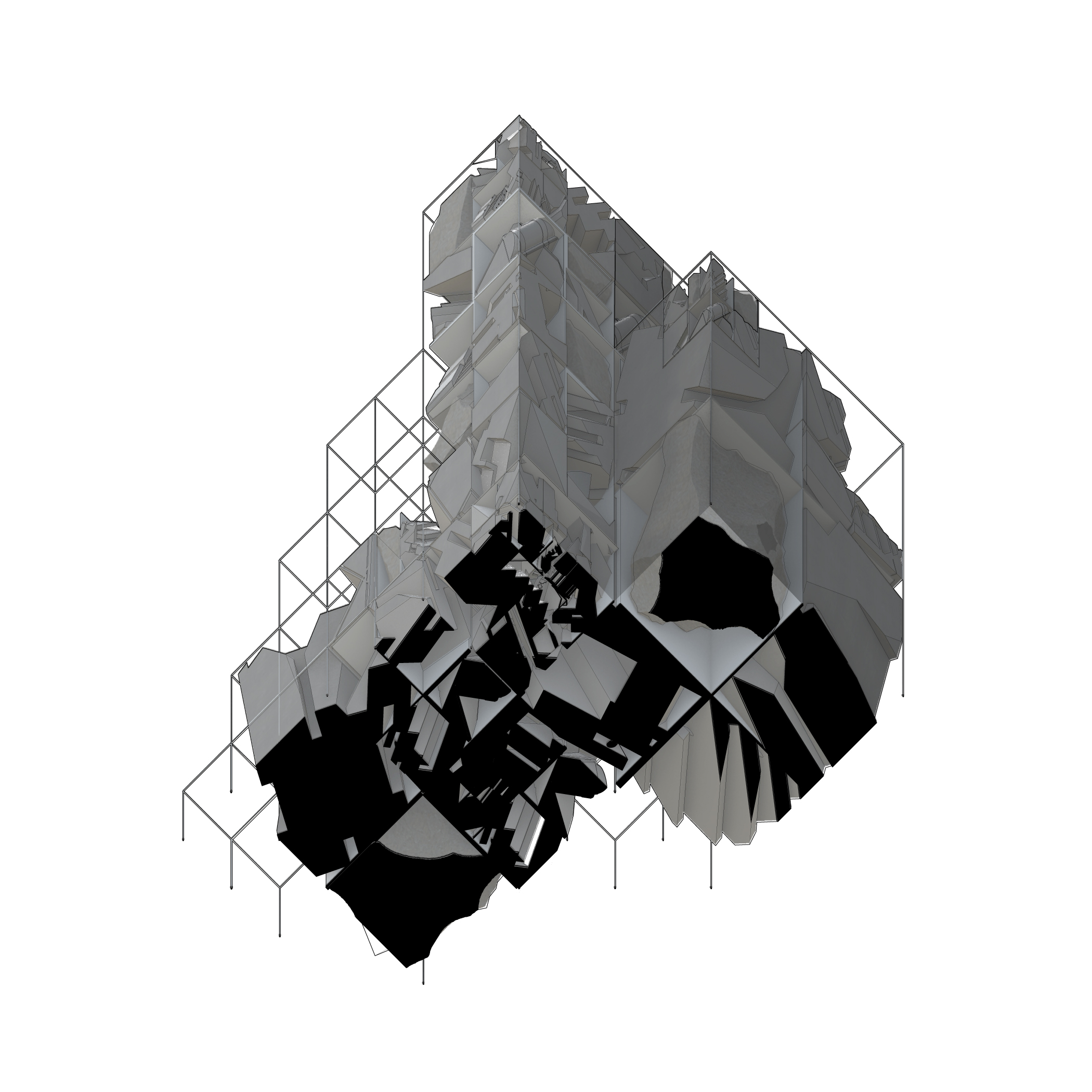
Studying the coexistence of architecture and the land, this thesis examines the tension between two systems of building—implicit patterns found in nature and the patterns of manmade grid—and translates that into a way of designing geometry from the bottom up. A cube is used as a neutral container, subdivided into smaller cubes within itself, where the grid forms something rigid. But through subdivision, the grid starts to behave almost like a natural pattern found in fractals. Within this system, fragments of architectural elements and blocks of stone are nested, cut up by the bounding cube and re-scaled, re-oriented, to become new objects each with its new identity decontextualized from past forms. When the two systems collide, interstitial spaces carved in-between the rough edges of the stone and the sharp cuts of architectural parts produce new pochés and voids, newfound experiential spaces made of existing structures.