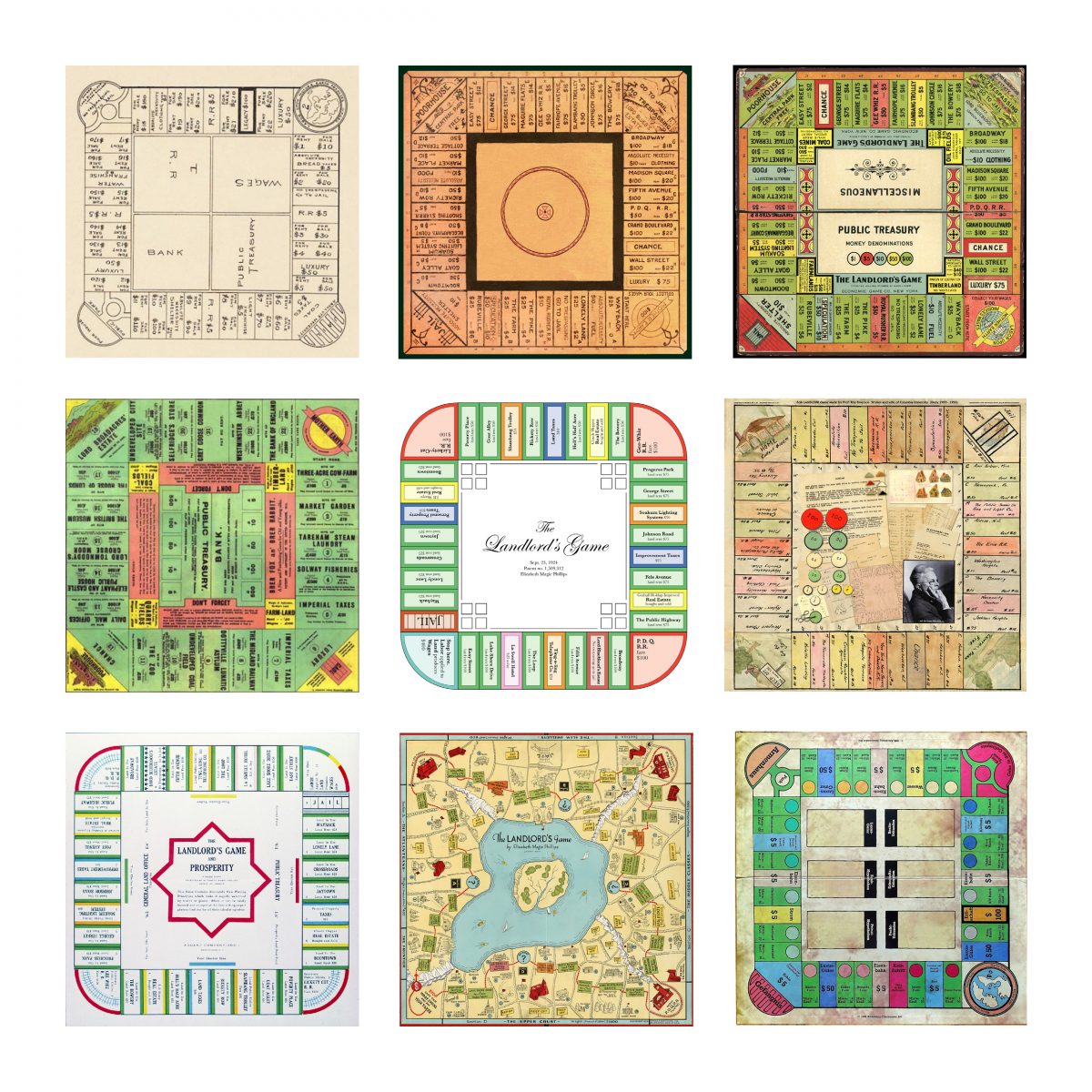
This studio explores new models of collective, affordable housing through two frameworks: Adaptive P/Re-use and Under New Ownership. Adaptive P/Re-use asks how we can design housing grounded in re-use—embracing the recirculation of materials, buildings, social structures, and environments as necessary. It also introduces pre-use, the idea that future adaptation, transformation, assembly, and disassembly—along with evolving social and ecological contexts—must be integral to design. Under New Ownership questions the dominance of real property systems and the commodification of housing that treat housing as a speculative asset rather than a human necessity. Under New Ownership asks to reimagine property and ownership by investigating forgotten, existing, and potential models—collective, shared, democratic, communal, public, and hybrid. These non-speculative approaches aim to provide long-term, affordable homes while creating a foundation for innovative and equitable housing design that responds to social and environmental realities.

NATURE’S WHISPER: A Cyclical Framework for Ecological Regeneration and Housing Systems for Altadena’s Recovery and Beyond
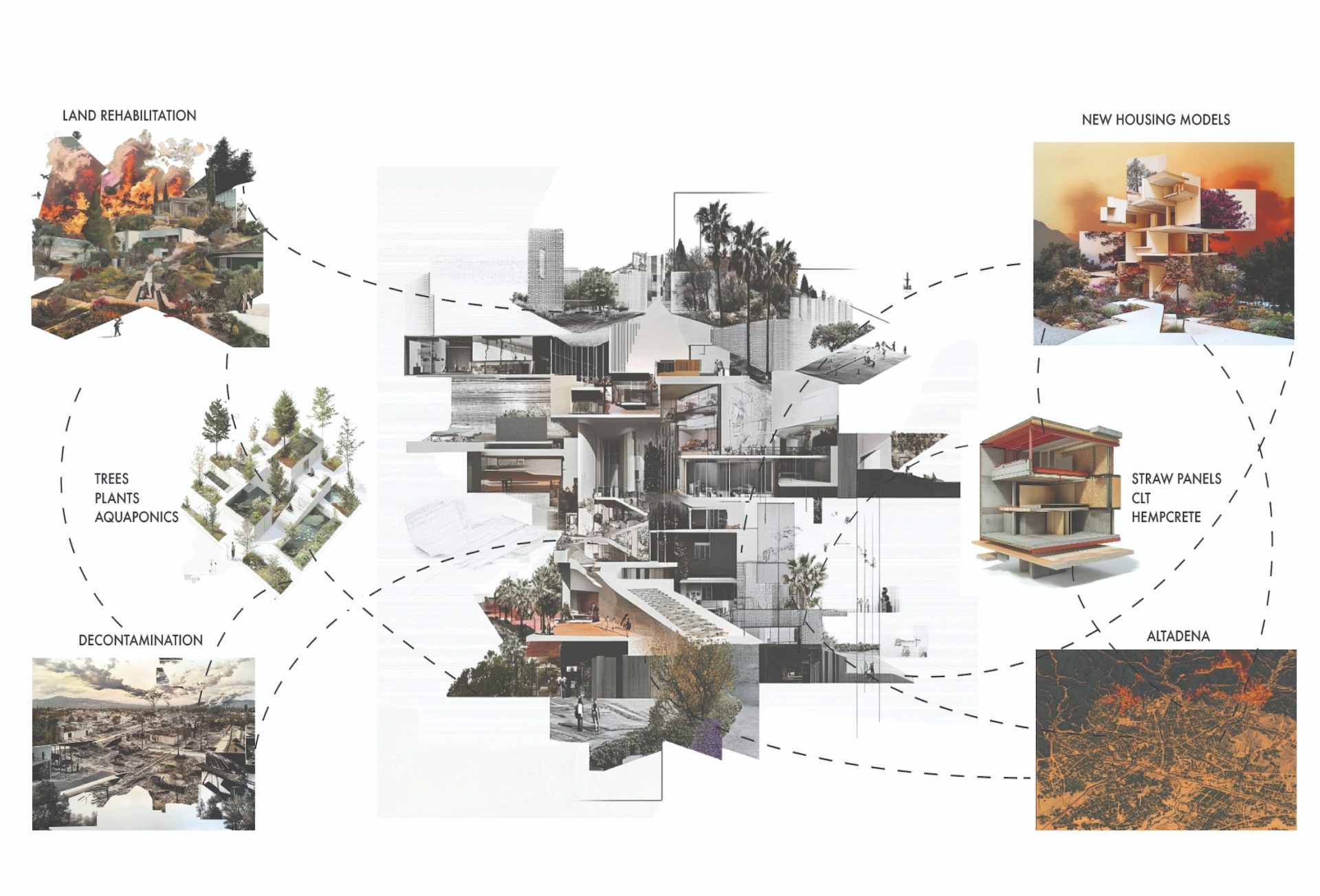
In Altadena, where homes meet the foothills, wildfires are no longer a distant threat—they are a devastating reality. In the wake of the Eaton Fire, which scorched large swaths of the community, Nature’s Whisper reframes fire not as an end, but as a beginning and a call for exploring new, alternative approaches to recovery. The project begins by transferring fire-damaged commercial lands and their surrounding parking areas into a Community Land Trust (CLT), enabling the pooling of resources and a long-term, collective process of recovery. Rooted in the metabolic processes of nature, recovery starts with the land itself—decontaminated and revitalized by native species such as chaparral, coast live oak, and soil-stabilizing grasses that filter toxins, replenish nutrients, and stabilize the terrain. While the land recovers, transitional and affordable housing for displaced residents is constructed atop the existing sealed surfaces and parking lots. The buildings too are considered a part of natural cycles, both materially and organizationally. Mainly crafted from timber, straw, hemp, and adobe, the structures themselves become part of a natural cycle of growth, consumption, and decay. At the same time, the buildings are designed for incremental adaptation and reconfiguration, allowing for various forms of occupancy and multiple rounds of alteration. Connected by the shared ground of the CLT, each housing cluster operates as a self-governed co-operative, overseeing its own evolution. With minimal footprints and open ground floors, the architecture invites nature to reclaim space while offering communal areas for social life and displaced public functions. Above, residents inhabit a tree-like structure according to their own needs. Rather than simply rebuilding what was lost, Nature’s Whisper thus embraces the tragic event as part of a larger ecological cycle—offering a regenerative, community-led framework for recovery that grows, adapts, and renews.

ReOCCUPY YOUR CITY: The Co-operative Squatting Society
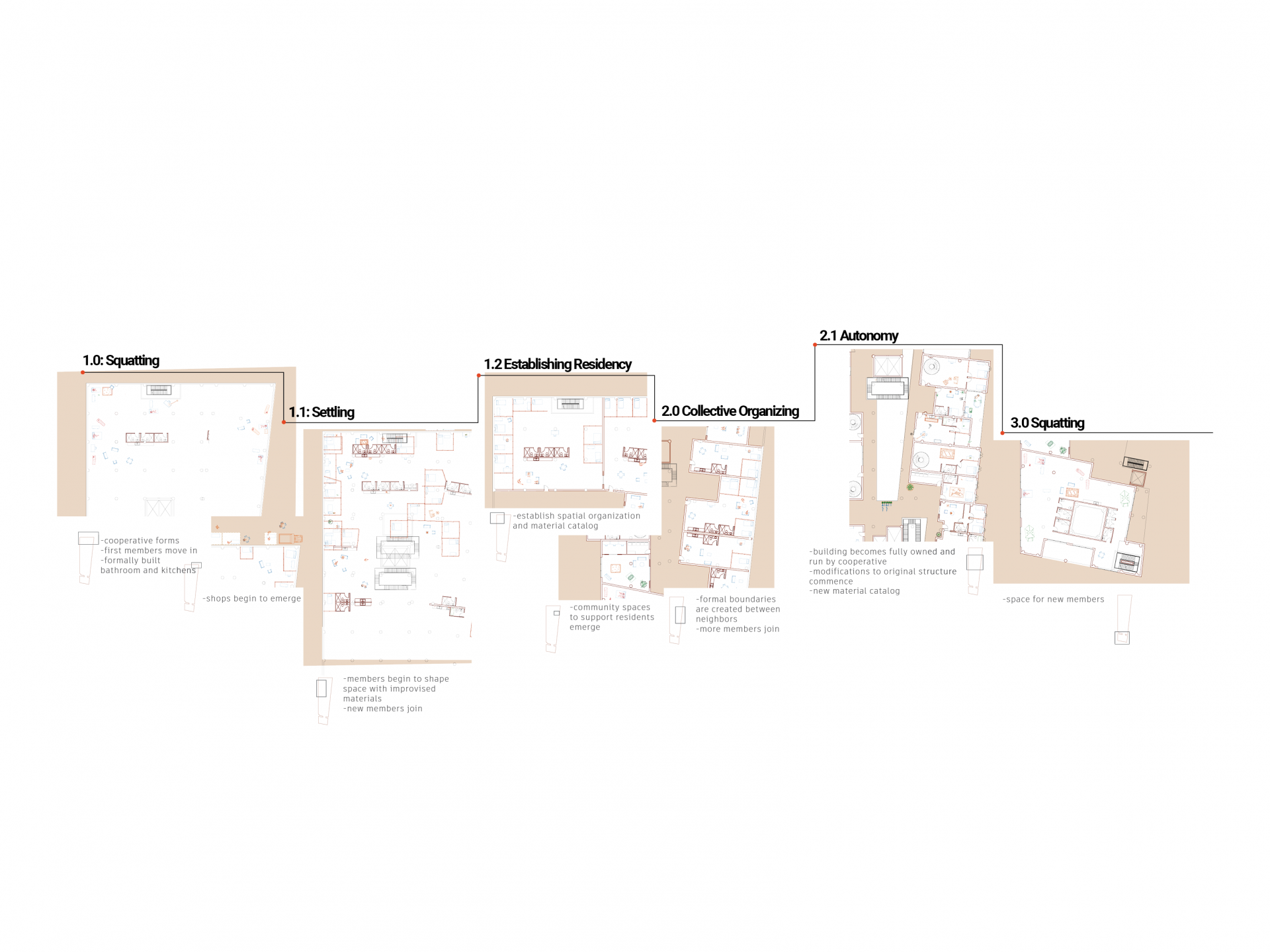
For many marginalized individuals and communities, informal practices are an essential means of gaining access to services and spaces that are otherwise unavailable or unaffordable. This is especially true for shelter and housing, where squatting often serves as a last resort. While property owners have broad legal means to evict squatters, squatters also hold limited rights, leading to often adversarial and protracted legal battles. ReOCCUPY Your City offers an alternative approach to squatting. By combining a supportive legal framework, a Pro-use Housing Policy, and formalized Co-operative Squatting Societies, it empowers squatters to take control of vacant industrial properties, transforming them into collaborative spaces that provide affordable housing for Los Angeles. Under the Pro-use Housing Policy, a group of dwellers can form a Co-operative Squatting Society, claim collective ownership of an abandoned building, and gradually inhabit and manage it democratically over time. As residents join, their involvement in the co-operative can evolve from emergency occupancy to transitional and ultimately permanent residency. ReOCCUPY Your City thus enables a community-driven, democratic reuse of vacant buildings, empowering squatters to not only claim and improve these structures but also to contribute to the city’s housing stock. The project also allows the city’s housing administration to make underutilized spaces progressively productive, offering affordable, self-governed housing solutions.
BUILDING WITH BRICOLAGE: BRICO and the Art of Reassembly: Building from What Remains – Reuse, Recovery, and Reimagination
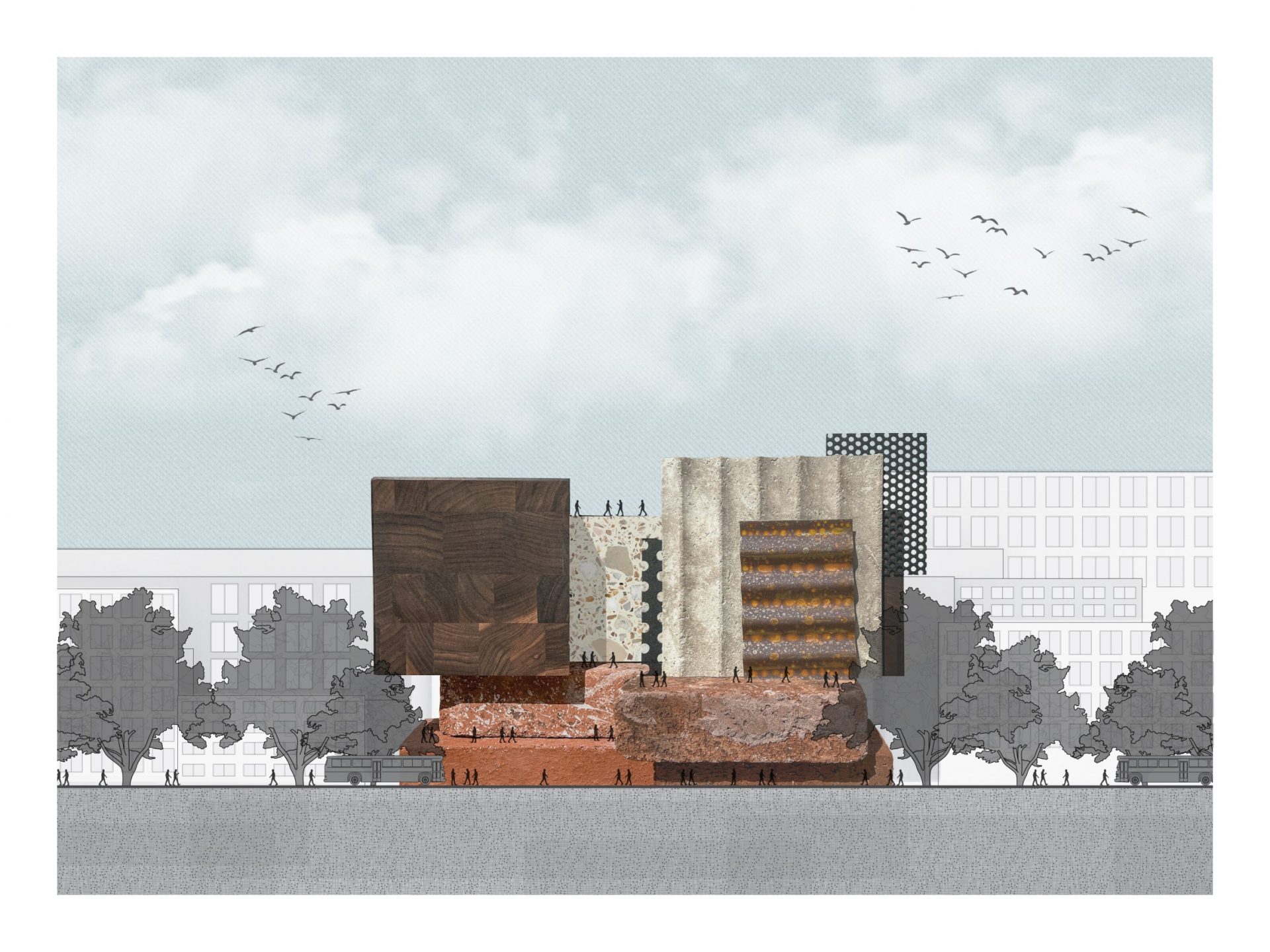
Building with Bricolage reimagines adaptive reuse as an active, regenerative process – one that is as much about creative material transformation as it is about collective social empowerment. This thesis proposes a framework where architecture is built not from scratch, but from what already exists: disassembled, deteriorated, and often overlooked structures are carefully taken apart, salvaged, and reassembled into new spatial forms. The resulting architecture is a collage—layered, expressive, and materially honest—where imperfections are not concealed, but celebrated. The visible seams, textures, and traces of former lives become part of the building’s identity, allowing it to tell a rich story of transformation. Rather than limiting adaptive reuse to historically conserved buildings, Building with Bricolage embraces the potential of “non-conservable” structures, reclaiming their materials for renewed construction on the same site. This process not only reduces waste and promotes sustainability, but also fosters hands-on skill-building in deconstruction, reassembly, and low-carbon construction practices. In partnership with the adjacent LA Trade and Technical College (LATTC), the project becomes a living classroom—integrating vocational training, experimentation, and community workshops to expand educational curricula and empower local labor. At its core, this framework positions architecture as a participatory act—shaped not only by materials, but by the people who inhabit, maintain, and co-create it. The proposed BRICO co-operative mirrors the material logic of bricolage: a diverse collective of residents and stakeholders, much like the varied components of the building itself, come together to form a unified, resilient whole. In doing so, Building with Bricolage regenerates more than buildings – it rebuilds the social fabric of the city through shared authorship, mutual care, and spatial storytelling.
COMMERCIAL TO COMMUNITY: Co-operative Material Banking for Non-speculative Housing – Circular Strategies for Reuse and Collective Ownership
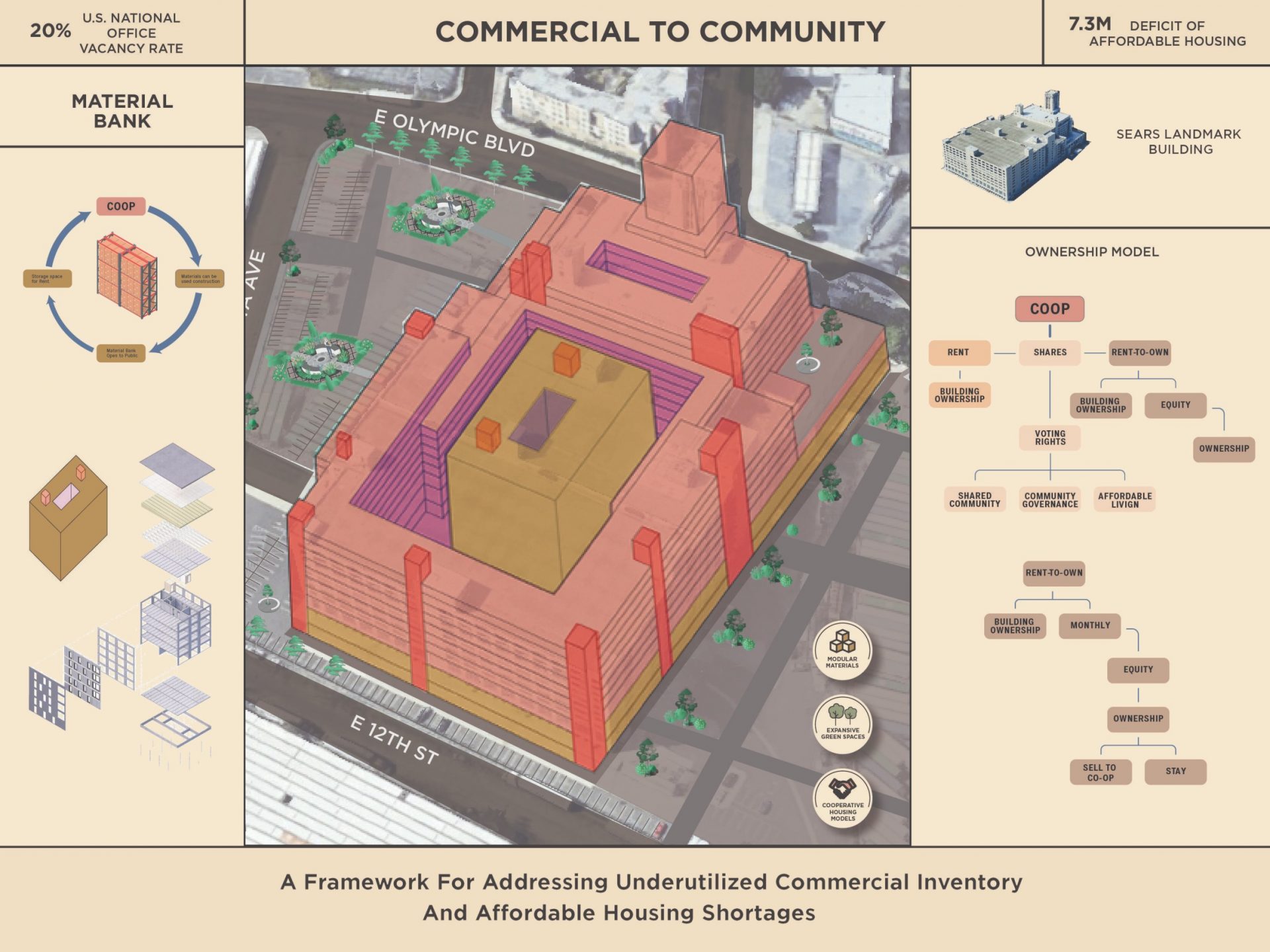
U.S. cities are grappling with a post-pandemic paradox: while 20% of commercial spaces—including office buildings—sit vacant, the country faces a shortfall of 7.3 million affordable homes, leaving just 34 available units per 100 low-income households. Commercial to Community addresses this disconnect by proposing a mutually reinforcing solution: transforming underused commercial assets into frameworks for non-speculative housing and circular entrepreneurship. Using the vacant Sears Building in Boyle Heights as a test case, the project reimagines adaptive reuse through two interlinked limited equity co-operatives. The Material Bank Co-op repurposes the bulk of the building into a general storage facility (gradually phased out) that generates early revenue. It also houses a permanent Material Bank—a hub for storing, researching, and testing circular construction materials as well as developing knowledge and skills for disassembly processes. In parallel, the Rent to Own – Own to Rent Co-op begins transforming the building’s frontage into housing. Here, Rent to Own members build equity through monthly payments, while Own to Rent members access stable, affordable rental options. As the residential program gradually expands into the former storage areas, the Material Bank continues to supply reclaimed materials for the construction industry across the city and produce modular (potentially resident-designed) plug-and-play elements. These enable co-op members to configure, merge, or customize their living spaces with flexibility and ease. By merging circular construction processes, incremental design, and collective ownership, Commercial to Community offers a replicable blueprint—where affordability, adaptability, and sustainability aren’t competing goals, but foundational principles of a resilient urban future.
INSIDE OUT / OUTSIDE IN: Collective Hybrids for Densified Suburban Dwelling
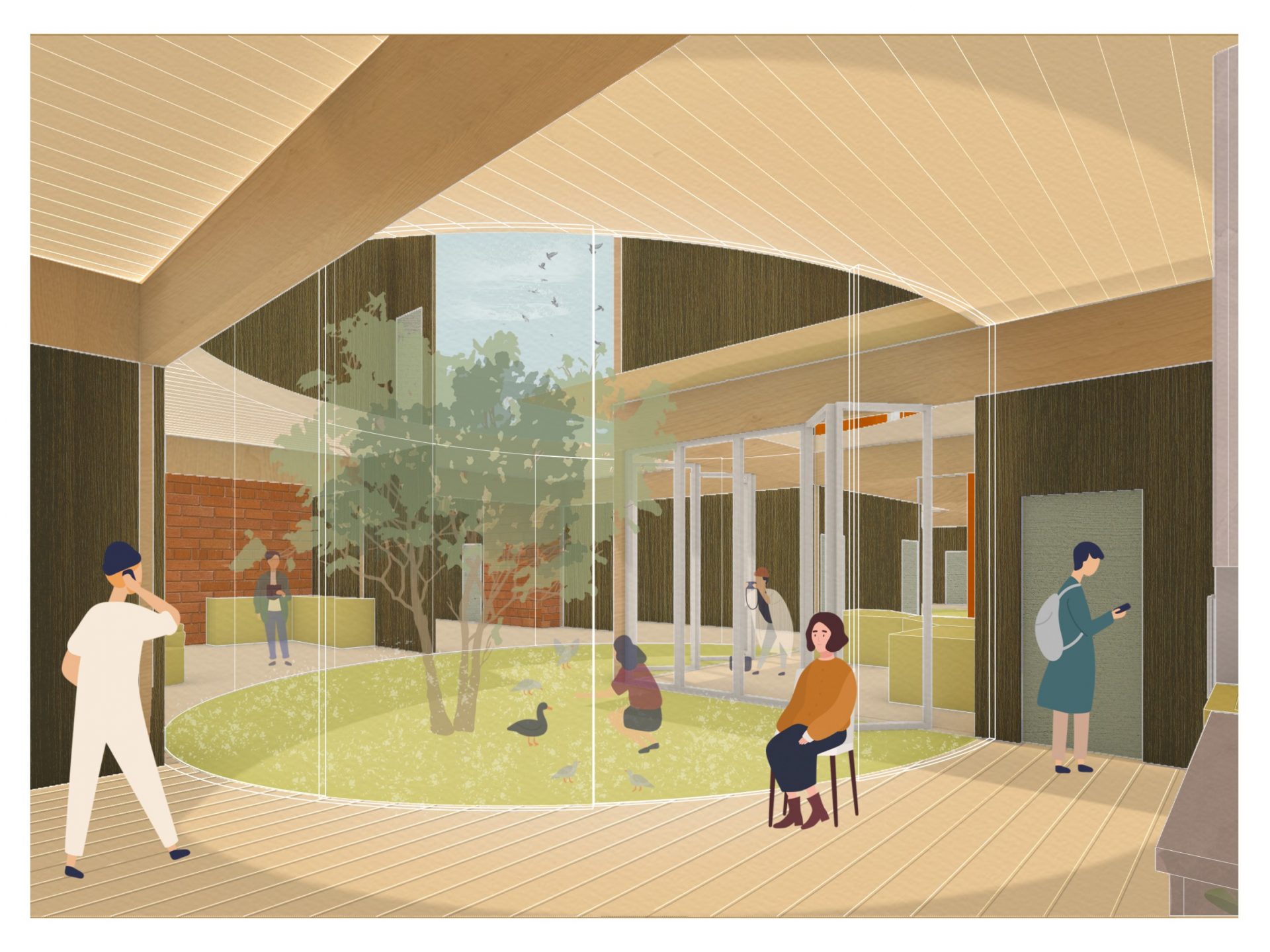
Inside Out / Outside In explores gentle suburban densification through the creation of collective hybrids—blending cooperative ownership, live-work arrangements, and flexible indoor-outdoor typologies. Anchored in a co-operative model, these hybrids promote adaptable, community-centered, and long-term affordable housing solutions. True to its title, Inside Out / Outside In addresses both spatial and organizational dynamics. Spatially, it rethinks the boundaries between interior and exterior environments. Conceptually, it draws from business common business strategies: “inside-out” approaches focus on leveraging internal capacities, while “outside-in” strategies prioritize responsiveness to user needs. In a cooperative setup—where members are simultaneously owners, producers, and users—these models converge. The result is a hybrid approach that simultaneously draws from collective strengths and serves shared needs. This hybridity operates on multiple levels throughout the project. Typologically, it proposes a coherent yet modular large-scale intervention that breaks down into neighborhood-scaled components—varying in massing and material expression and integrating local and reused building elements. Programmatically, it interweaves residential units with business and maker spaces, fostering a cooperative hub for co-creation, entrepreneurship, and mutual support. Set in post-fire Altadena, the project not only introduces new and denser forms of housing to support recovery, but reimagines the suburban landscape as a regenerative, self-governed hybrid. It envisions a tightly interlaced network of shared indoor and outdoor environments, enabling collective living and working within a resilient and sustainable community structure.
FRAMEWORKS TO FREEDOM [F2F]: From Standardized Atomized Dwelling to Flexible Collective Living
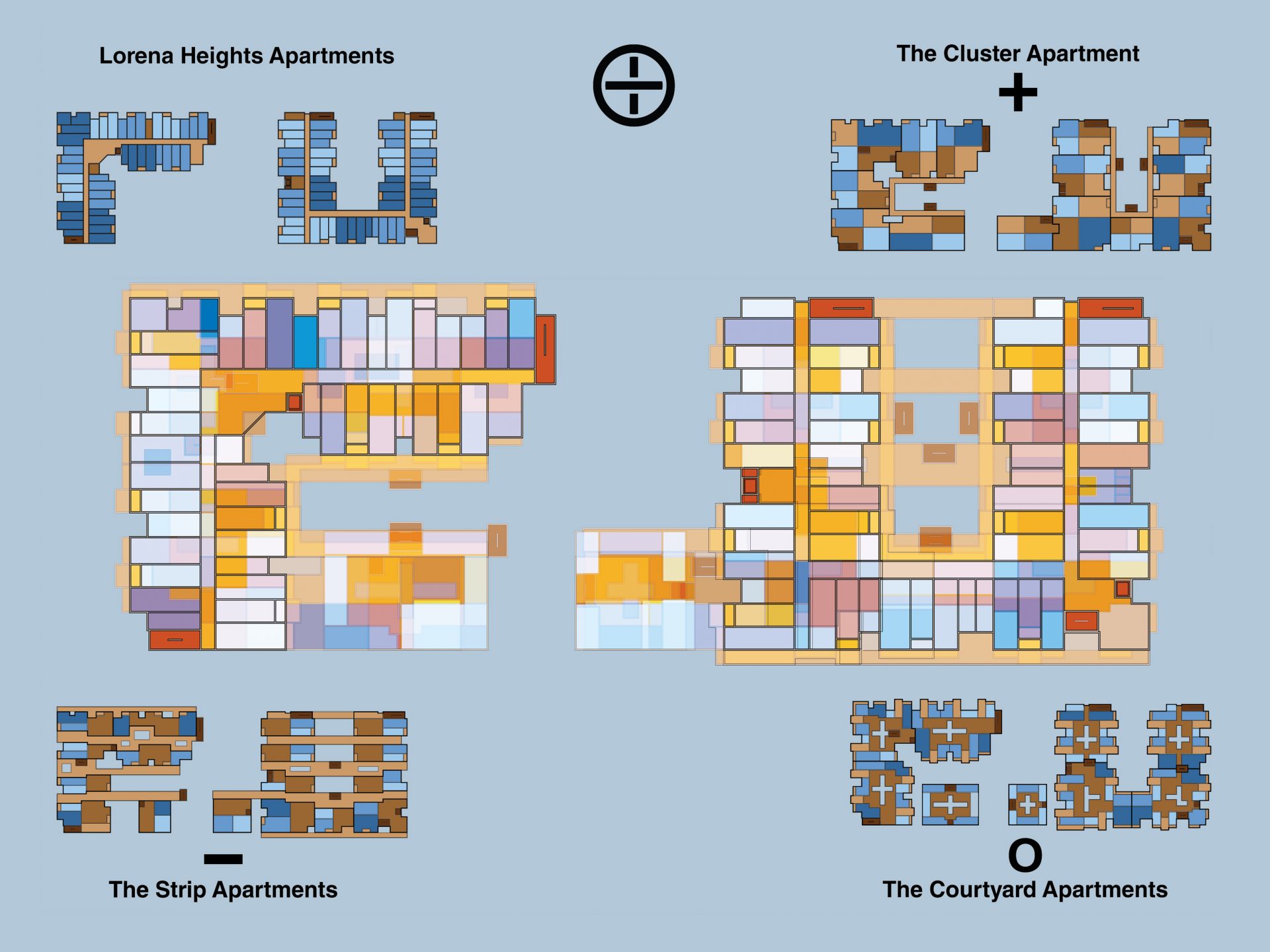
Frameworks to Freedom builds on John Habraken’s Open Building concept, which proposes a dynamic relationship between a fixed structural framework and adaptable infill, striking a balance between architectural control and resident-led customization. While Habraken’s vision typically applies to newly constructed frameworks, this project explores how existing housing typologies can be transformed to enable similar freedoms. Focusing on the highly standardized “5-over-1” building—a common urban typology consisting of a concrete podium, up to five wood-framed stories, double-loaded corridors, and generic one- and two-bedroom units—Frameworks to Freedomproposes both physical and organizational strategies to retrofit these structures for affordability and resident empowerment in underserved communities. First, the project reimagines these buildings as nonprofit cooperatives, allowing residents to collectively own and manage their housing while fostering community resilience. Second, it introduces a subscription-based system that enables individuals or families to select among tiers of amenity access, unit sizes, and finish levels—providing flexibility aligned with residents’ spatial needs and financial situations. Third, Frameworks to Freedom outlines three spatial transformation types—the Strip, the Cluster, and the Courtyard—which can be adapted to various contexts and building conditions. All three challenge the rigidity of the double-loaded corridor layout, replacing it with generous shared outdoor areas and collective living spaces, while allowing for flexible, reconfigurable private units. Using the Lorena Apartments in Boyle Heights as a case study, the project illustrates how a standardized nonprofit development can evolve into a flexible, resident-owned, affordable housing model—transforming not only the built environment, but the lives of those who inhabit it
COMMUNITY HEALTH HOUSING: From Mental Health Architecture to Architecture of Well-Being
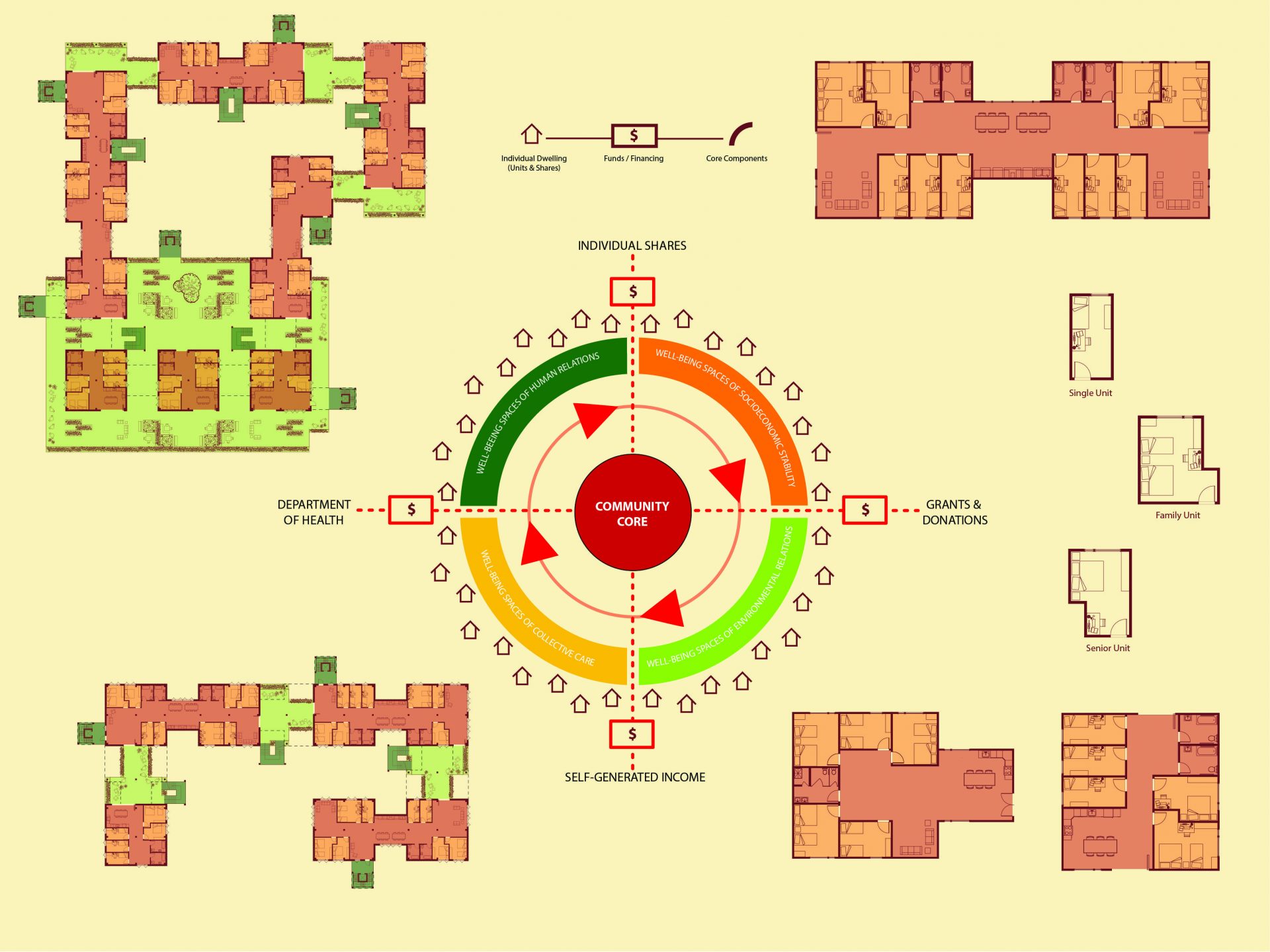
Community Health Housing explores how architectural design and collaborative ownership models can actively support mental well-being. Rather than responding solely to acute mental health crises, it seeks to create preventive living environments that address everyday mental stressors—such as social isolation, eviction anxiety, and challenging family dynamics—before they escalate. Situated next to White Memorial Hospital in Boyle Heights, the project extends mental health infrastructure by providing access to outpatient care, wellness programs, and preventative services. Beyond healthcare, Community Health Housingensures long-term affordability, housing stability, and resident participation through a limited equity cooperative model. Financed through a mix of public funding, non-profit and charitable contributions, and resident shares, the project also includes a solidarity fund to support inhabitants facing temporary financial hardship. The development is built around community cores and shared spaces at multiple scales—outdoor gardens, collective living rooms, semi-private terraces, and shared kitchens—designed to foster social connection and collective activity. The Community Health Housing Activity Fund empowers residents to use these spaces for personal and communal initiatives like gardening, woodworking, or music-making. Finally, the project introduces a modular, flexible layout system that accommodates diverse living arrangements—from nuclear and multigenerational families to chosen families, communes, and co-living groups. By embracing this architectural adaptability, Community Health Housing envisions an architecture of well-being that responds to the complex realities of urban life and reduces the everyday pressures that impact mental health.
SUBVERSIVE SUBURBS: Join the Altadena Land Trust Alliance
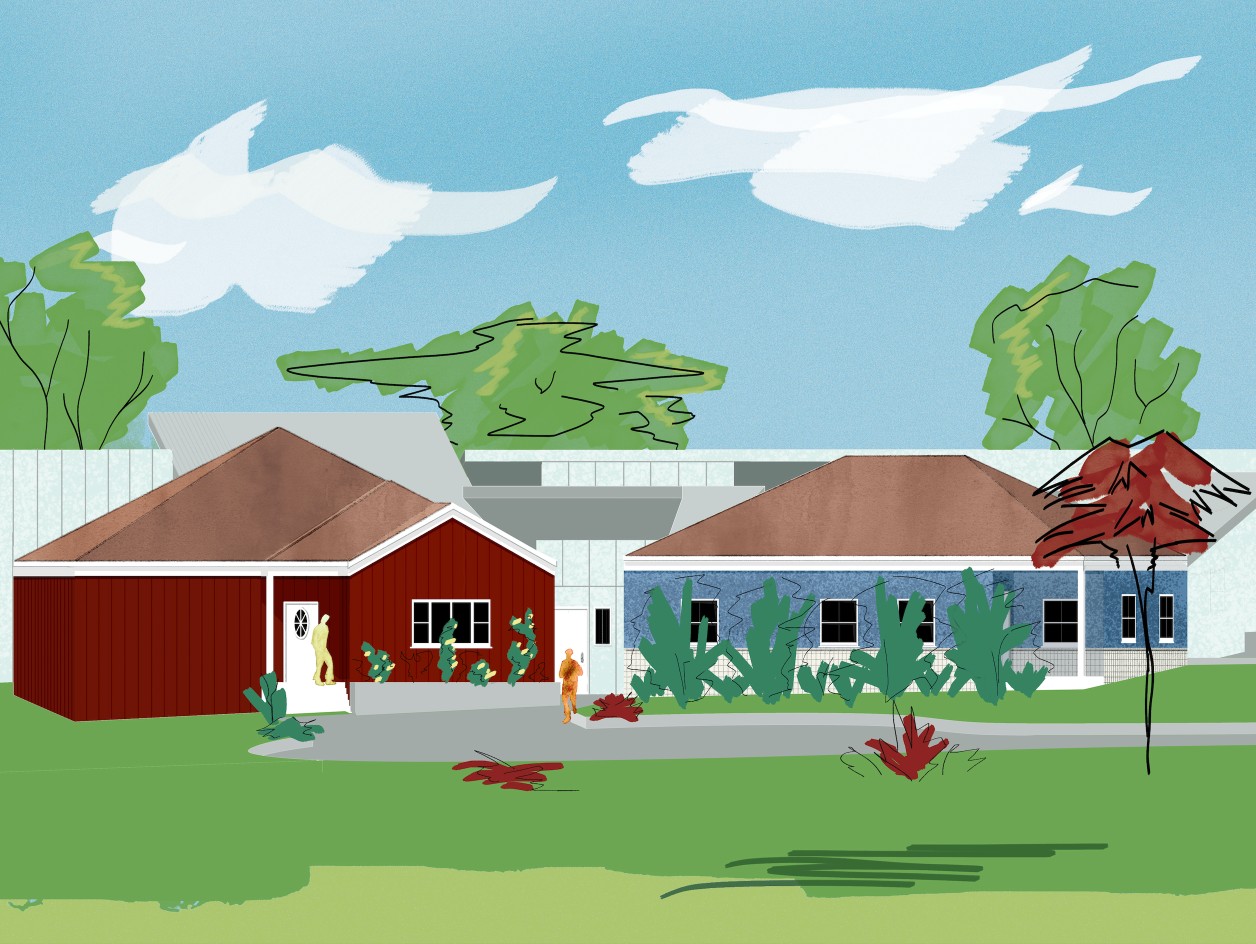
The typical residential subdivisions that define much of the housing supply in the U.S. have drawn persistent criticism from architects and planners. Suburban sprawl has contributed to car dependency, social atomization, and an affordability crisis fueled by land speculation and debt. While urban co-ops and rural utopian communities have attempted to address some of these structural issues, “suburbia” remains deeply tied to conventional forms of ownership, use, and consumption. Subversive Suburbs argues for the adaptation of suburbs into sites that resist, rather than reinforce, these socioeconomic norms. Using post-wildfire Altadena as a case study, this proposal for a Community Land Trust (CLT) and affiliated incentives retains the area’s suburban character while supporting more resilient, collective lifestyles. The envisioned Altadena Land Trust Alliance (ALTA) offers residents who lost their homes the opportunity to convert their land titles into shares in a new housing cooperative that gradually but efficiently redevelops the neighborhood. ALTA incentivizes collectivization by allowing members to build under a new zoning framework, adding a variety of shared infrastructure and amenities without sacrificing affordability. The project thus subverts both the formal and economic logic of suburban development, creating an alternative vision for the future of this contested typology.
THE HEAD & THE HEART: Building for Stability in Mental Illness
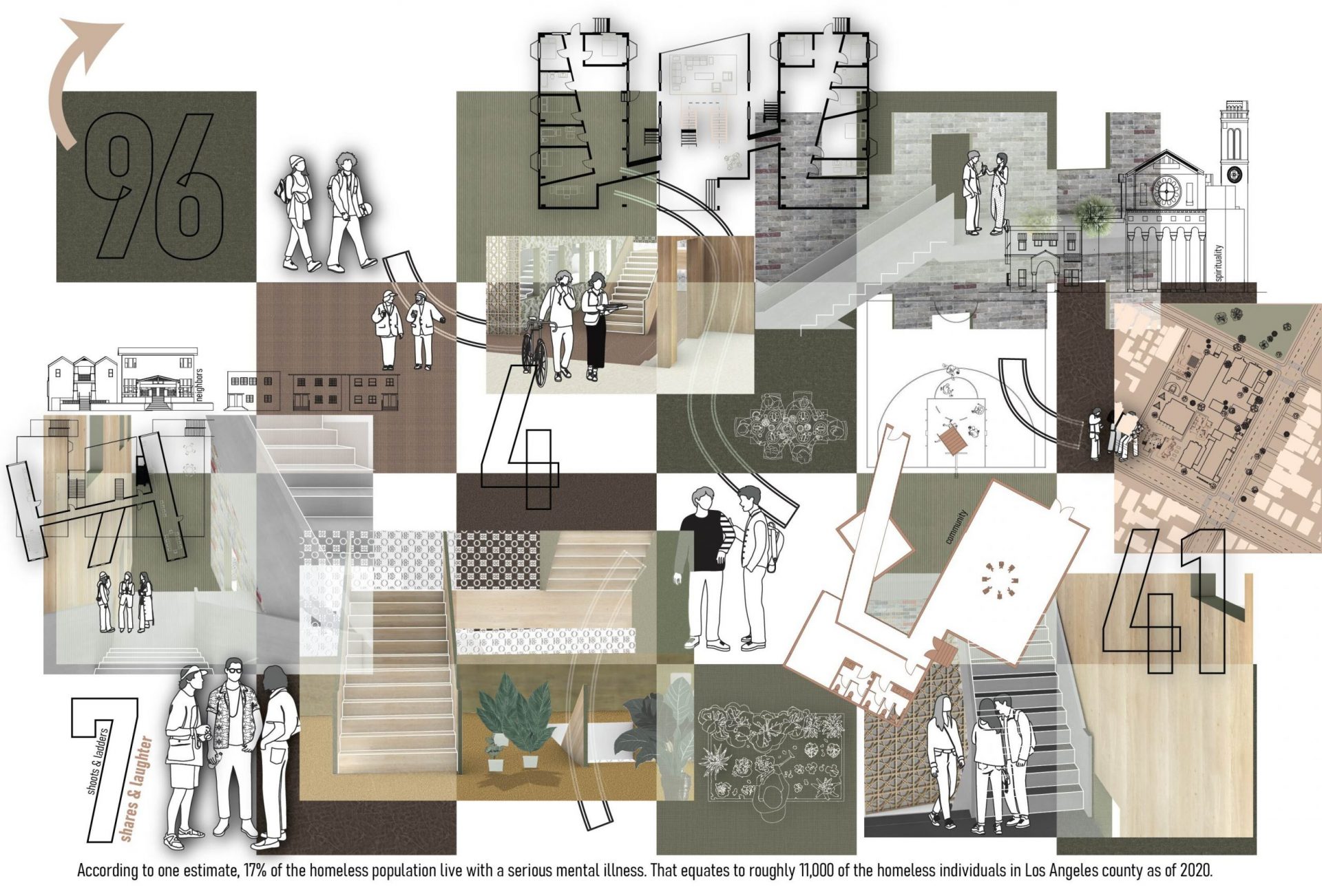
Access to stable housing is essential for individuals living with mental illness and manifests in various forms—from clinical institutions to supervised group homes to supportive housing—each presenting distinct challenges, including affordability, autonomy, physical needs, and freedom from discrimination. Responding to the diminishing availability of affordable housing in Los Angeles, The Head & The Heart proposes a long-term, multi-layered strategy to support individuals with mental illness. First, it expands upon the Housing First model, which has demonstrated improved mental health outcomes and reduced homelessness by prioritizing immediate, unconditional access to permanent housing. Second, it incorporates a limited equity cooperative model that ensures long-term affordability while empowering residents as collective owners, participants, and decision-makers in their communities. Third, it establishes inclusive design principles that support mental well-being by offering a blend of secure, open, intimate, and communal spaces—featuring constant visual connections to the outdoors, central communal areas, open-ended circulation paths, shared kitchens, multi-story collective spaces, and private nooks for retreat. Finally, The Head & The Heart embeds its housing units and supportive programs (such as caretaker residences, a community center, and green spaces) within existing urban sites to form integrated, mutually supportive compounds. One proposed collaboration is with St. Mary’s Catholic Church and its affiliated school in Boyle Heights. Jointly funded by the church and public agencies at the federal, state, and city levels, the project reimagines the site as a shared estate—providing stable housing while enriching the broader community through accessible, communal programming.
FORM FOLLOWS AVAILABILITY: Urban Mining and the Architecture of Collective Resources
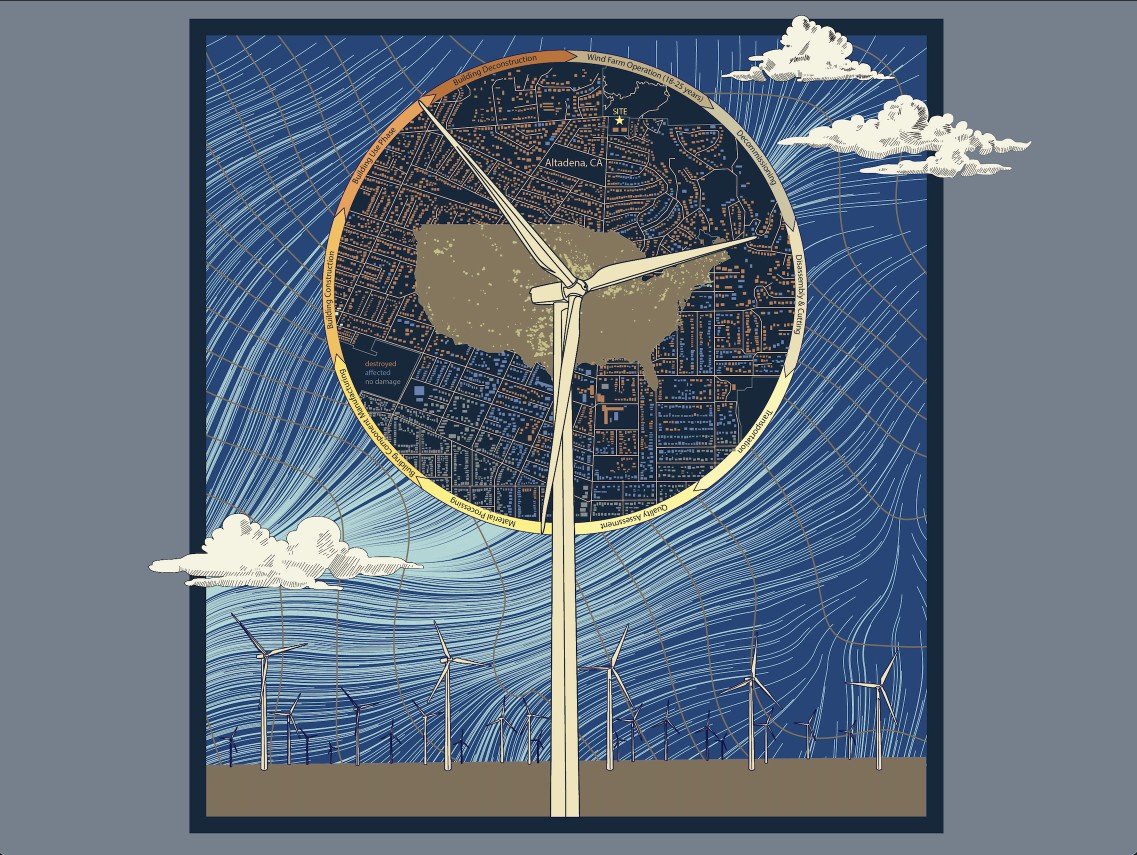
Since humans first built shelters, architectural form has been dictated by material availability—a fundamental principle that modern construction practices have abandoned through unsustainable extraction cycles. This thesis reclaims and reframes this logic for contemporary practice through a comprehensive urban mining framework that reconceptualizes industrial waste as collective architectural resources. Using decommissioned wind turbines as a primary case study, it demonstrates how systematic material recovery can address both environmental sustainability and housing affordability while responding to immediate climate-related disasters. With 70,800 wind turbines currently operating in the United States, and projections showing over 3,000 blades reaching end-of-life annually by the 2030s—potentially generating 2 million tons of waste in the U.S. alone by 2050—this framework establishes a scalable system for material recovery and redistribution. Drawing on Elinor Ostrom’s understanding of common-pool resource management, the approach creates a collectively managed material bank where recovered industrial components become accessible building materials for affordable housing developments on city-owned land. Situated on a vacant lot in Altadena, California—a neighborhood devastated by recent wildfires—this proposal directly addresses the urgent need for recovery and reconstruction. The site plan follows the natural topographic water flow to prevent mudslide damage, directing water into an existing abandoned reservoir. By reintegrating engineered composites into residential architecture, the framework reduces construction costs while advancing material-driven design methodologies where form again follows availability. This shift from extraction to curation fundamentally transforms architectural practice, reconnecting it with its historical roots while addressing contemporary challenges of sustainability, waste management, housing accessibility, and climate resilience in urban environments.
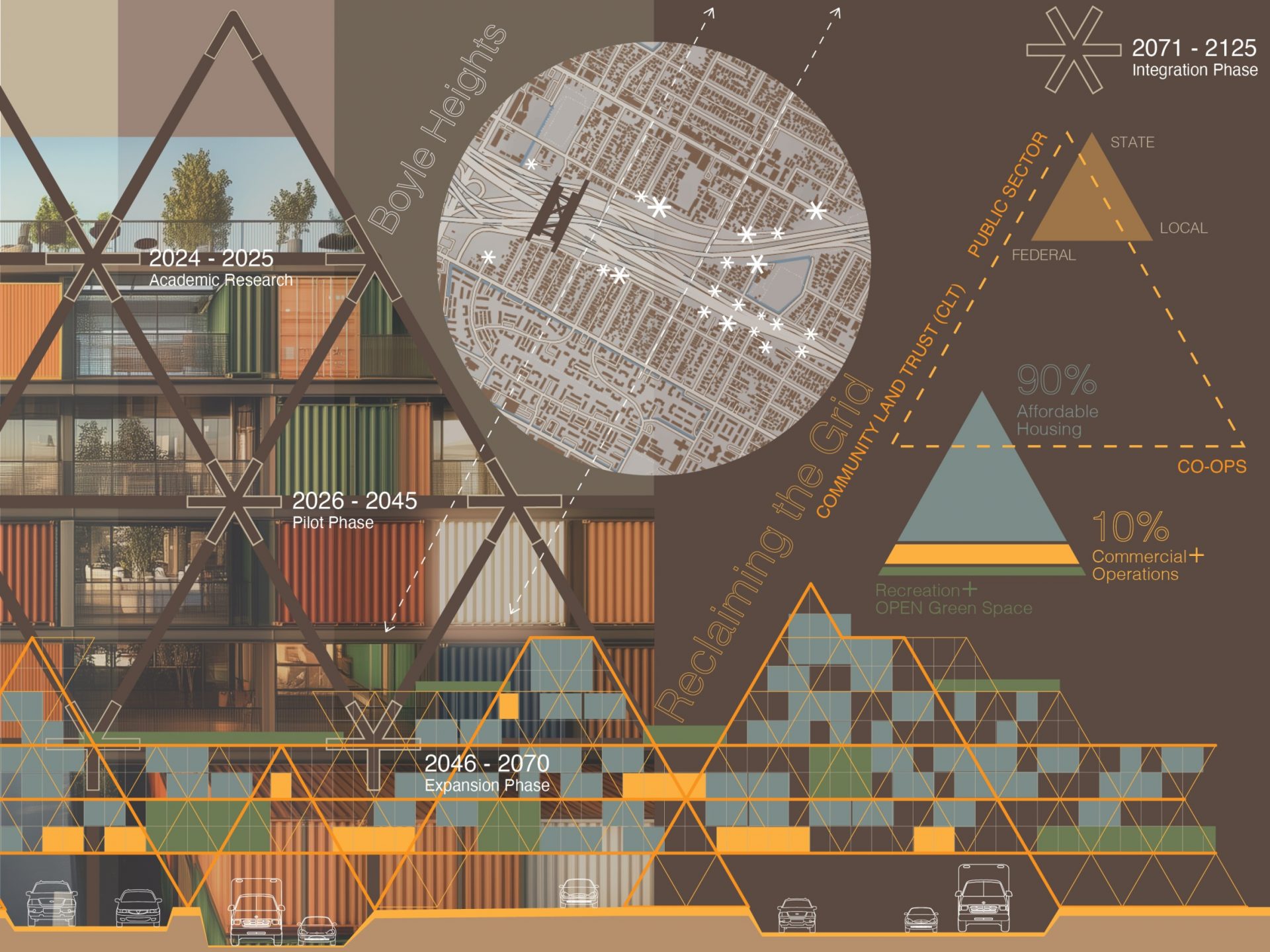
RECLAIMING THE GRID: Public and Hybrid Infrastructure for Adaptive Community-Owned Housing
Reclaiming the Grid seeks to reconnect the fragmented urban fabric of Boyle Heights, disrupted by the massive convergence of the 101, 5, and 60 highways. Since the land and rights-of-way occupied by these highways are publicly owned, the project proposes not only to mend severed streets and communities with new connections and bridges, but also to repurpose infrastructure funding to create new public land above the highways. By spanning the highway with a modular, hybrid structure, this ‘reclaimed’ land becomes a platform for new affordable housing. Grounded in public investment, the project introduces a hybrid ownership and governance model that resists speculation. While the structural framework is publicly owned and maintained, the newly created surface properties are transferred to a Community Land Trust (CLT). The CLT manages and leases these properties to a range of limited-equity housing cooperatives, which can apply for long-term leases tailored to varying property sizes. With cooperatives collectively owned and operated by their members, Reclaiming the Grid envisions a multi-tiered, community-owned bridge and housing system that challenges monofunctional infrastructure and profit-driven development. Although the primary span must be constructed at once, the project is designed for incremental vertical and horizontal expansion over decades using a modular, adaptive framework. This modularity is embedded at multiple levels: the core structure is composed of reused steel beams, allowing for phased assembly and future expansion, while the housing units are delivered through prefabricated systems such as shipping containers, manufactured homes, or other modular typologies—depending on the preferences of each cooperative. Through the CLT’s stewardship and the diversity of cooperative communities inhabiting the evolving structure, Reclaiming the Grid not only reweaves and extends the neighborhood—it fosters resilient, self-governed, and non-speculative housing for the long term.