
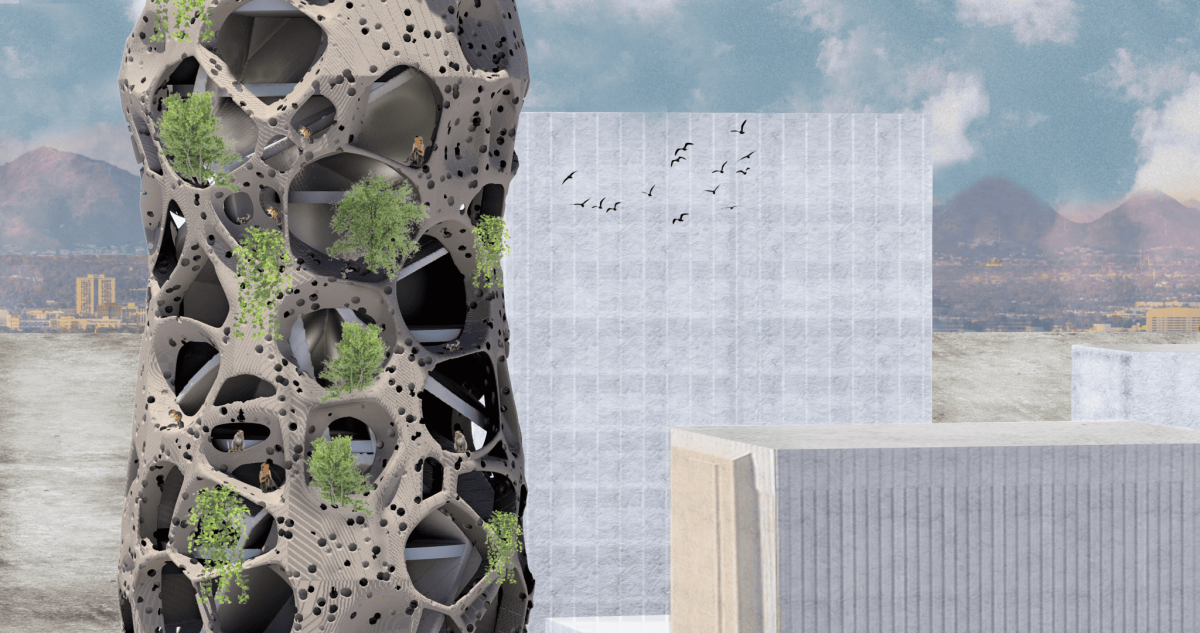
Natural systems often display a balance of order and randomness—seen in honeycombs, soap bubbles, and plant growth—demonstrating highly evolved, efficient solutions developed over millennia. Designers have long drawn on such biological intelligence to solve architectural challenges. Bio-inspiration, encompassing bionics, biomimetics, and bioinformed design, offers powerful strategies for enhancing performance.
This thesis explores how AI tools can be leveraged to translate biomimetic principles into three-dimensional architectural forms, with a focus on performance-driven outcomes. Set in Phoenix’s arid climate, the Cholla cactus serves as a model. Its interlocking, lightweight skeleton informs a structural system optimized for strength, material efficiency, and environmental responsiveness.
The proposed design uses a composite of desert sand and organic binders, reducing material impact while enhancing ventilation, passive cooling, and daylighting. Ultimately, this research investigates how AI and biomimicry together can drive high-performance, sustainable architecture rooted in natural intelligence.