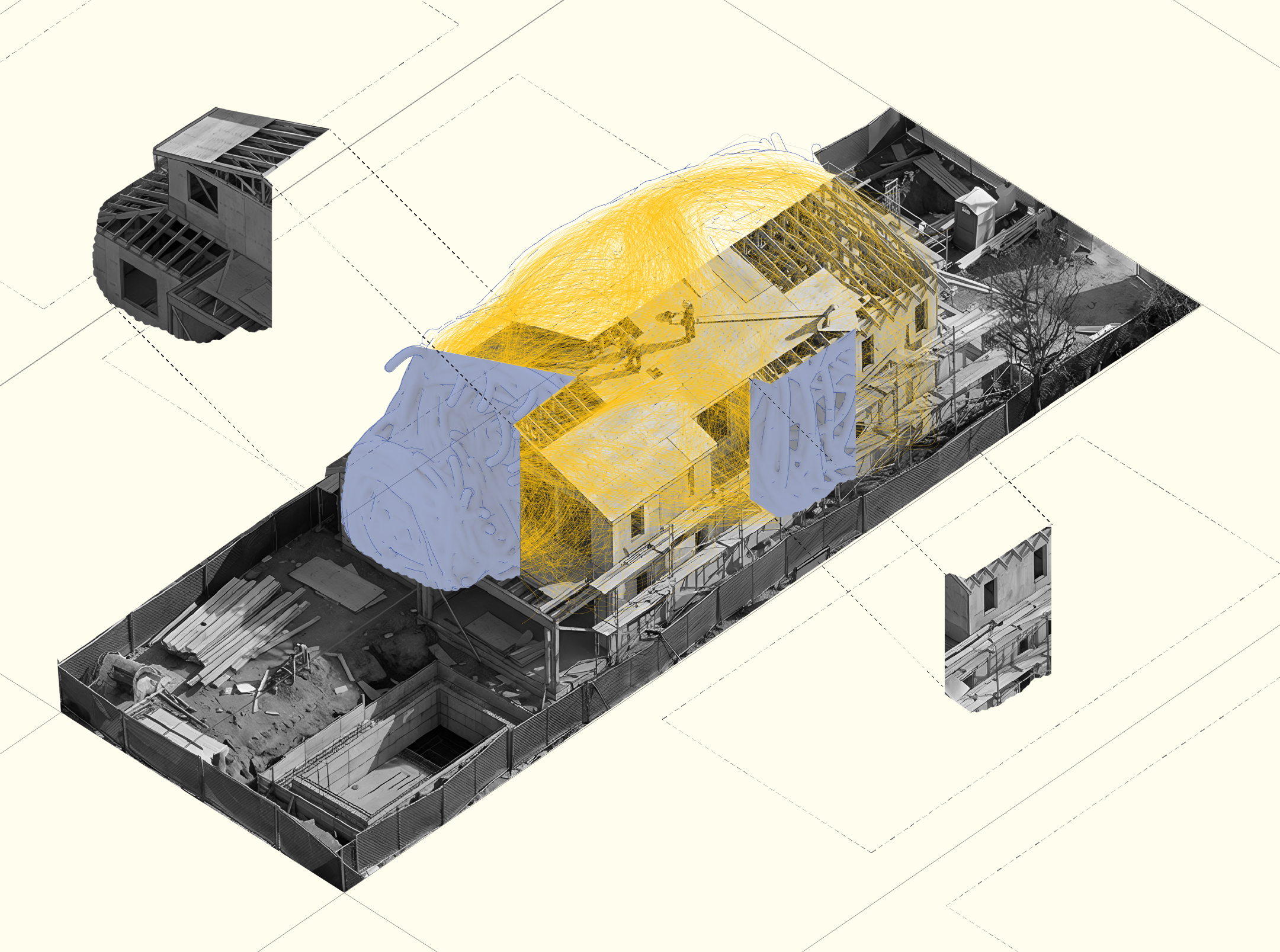
A Decentralized Design Approach to Extreme Weather Conditions Drawing on the organizational logic of biological swarms, this thesis proposes a new housing typology for Pacific Palisades that adapts to the site's wildfire risk, wind conditions, and topographic instability. This project investigates how housing as an interdependent system, can redistribute risk, protect, and evolve in response to environmental extremes.
In the aftermath of the 2025 Pacific Palisades fires, displaced residents face pressure to rebuild quickly, returning to the same forms of construction that accelerated the original destruction.
Swarm-Form proposes a housing typology that uses extreme conditions to create form finding solutions. Drawing from swarm intelligence: the natural phenomenon where systems respond, reconfigure, and thrive collectively rather than individually, the project develops a form-finding methodology driven by site-specific environmental forces. Pacific Palisades serves as an example into a broader climate question: how architecture, conceived as an adaptive system, can generate rapid, site-specific responses to environments defined by extremes.